
Most commercial building owners assume that when a roof starts showing its age, full replacement is the only option. That assumption costs property owners thousands of dollars every year – because in many cases, a roof that looks tired and weathered is still structurally sound enough to be restored rather than replaced.
Commercial roof restoration is the process of cleaning, repairing, and re-coating an existing roof system to extend its useful life by 10-15 years – at roughly 30-50% of the cost of a full replacement. When done correctly on a qualifying roof, it delivers better energy performance, renewed waterproofing, and a manufacturer-backed coating warranty without the noise, disruption, and landfill waste of a tear-off.
This article answers the most important questions building owners ask: what restoration actually involves, the step-by-step process from inspection to completion, how long commercial roofs last, how they are built, the five main types of commercial roof construction, and when restoration is the right call versus replacement.
To learn more about Cool Roofs’ approach, visit our Commercial Roof Restoration Services page.
What Is Commercial Roof Restoration?
Commercial roof restoration is not a repair and it is not a replacement. It is a comprehensive process that renews an aging but structurally sound roof by addressing all surface defects, reinforcing weak points, and applying a seamless fluid-applied coating system over the existing membrane.
The result is a restored roof that:
- Has renewed waterproofing and UV protection
- Meets Energy Star reflectivity standards (in most cases, significantly improving on the original membrane’s solar reflectance)
- Carries a new manufacturer-backed coating warranty – typically 10-20 years
- Has extended its useful service life by 10-15 years without the cost or disruption of tear-off
Restoration is compatible with most commercial roofing systems – TPO, modified bitumen, EPDM, BUR, metal, and spray polyurethane foam – provided the existing roof meets the qualifying criteria, which primarily comes down to structural integrity and moisture content in the insulation.
How Long Will a Commercial Roof Last?
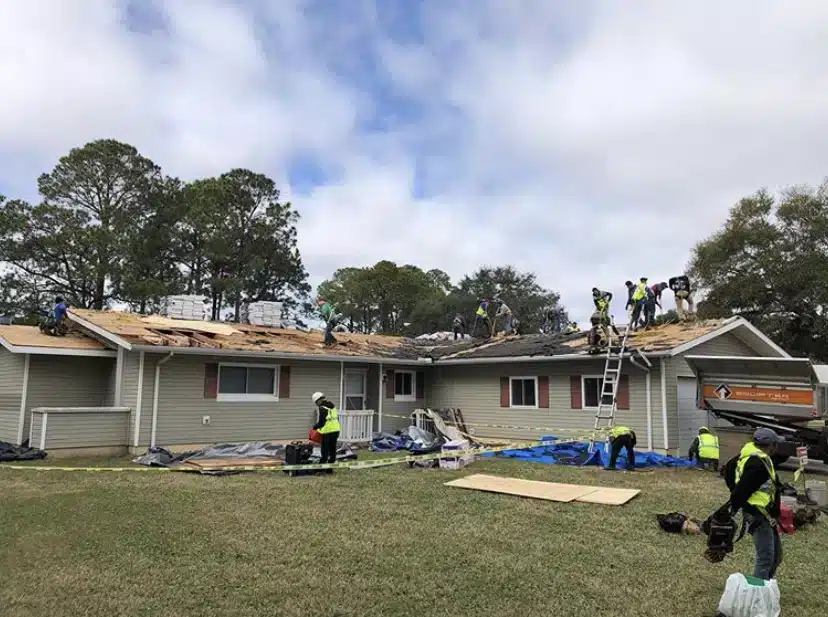
Texas heat, hail, and storm exposure wear down commercial roofs faster — most become restoration candidates around the 10–15 year mark.
This is one of the most common questions building owners ask, and the honest answer is: it depends significantly on the system, the installation quality, the climate, and how consistently the roof is maintained.
Here is a realistic breakdown by system type, including how restoration affects total service life:
| Roof Type | Typical Lifespan | With Restoration | Notes |
| TPO (single-ply) | 15-25 years | +10-15 years | Coating restores reflectivity |
| Modified Bitumen | 15-20 years | +10-15 years | Most commonly restored in Texas |
| EPDM (rubber) | 20-25 years | +10-15 years | Liquid coating bonds well to rubber |
| PVC (single-ply) | 20-30+ years | +10-15 years | Less common candidate; longer native life |
| Built-Up Roofing (BUR) | 15-30 years | +10-20 years | Excellent restoration candidate |
| Metal Roofing | 30-50 years | +10-20 years | Coating addresses rust and seam leaks |
In Texas specifically, the combination of intense UV radiation, high summer temperatures, hail risk, and storm activity places commercial roofing systems under more stress than in most other markets. Roofs that might reach the upper end of their lifespan in a moderate climate will often land closer to the lower end in Texas without a proactive maintenance and restoration program.
The practical takeaway for building owners: most commercial roofs become candidates for restoration at the 10-15 year mark, before they reach the point of widespread failure. Catching the roof in the right condition – before moisture has saturated the insulation or the membrane has cracked extensively – is what makes restoration viable. Waiting too long converts a $30,000 restoration candidate into a $100,000 replacement.
For a professional assessment of your roof’s current condition and remaining useful life, our Commercial Roofing inspection team provides a full photo-documented report and transparent restoration or replacement recommendation.
How Is a Commercial Roof Built?
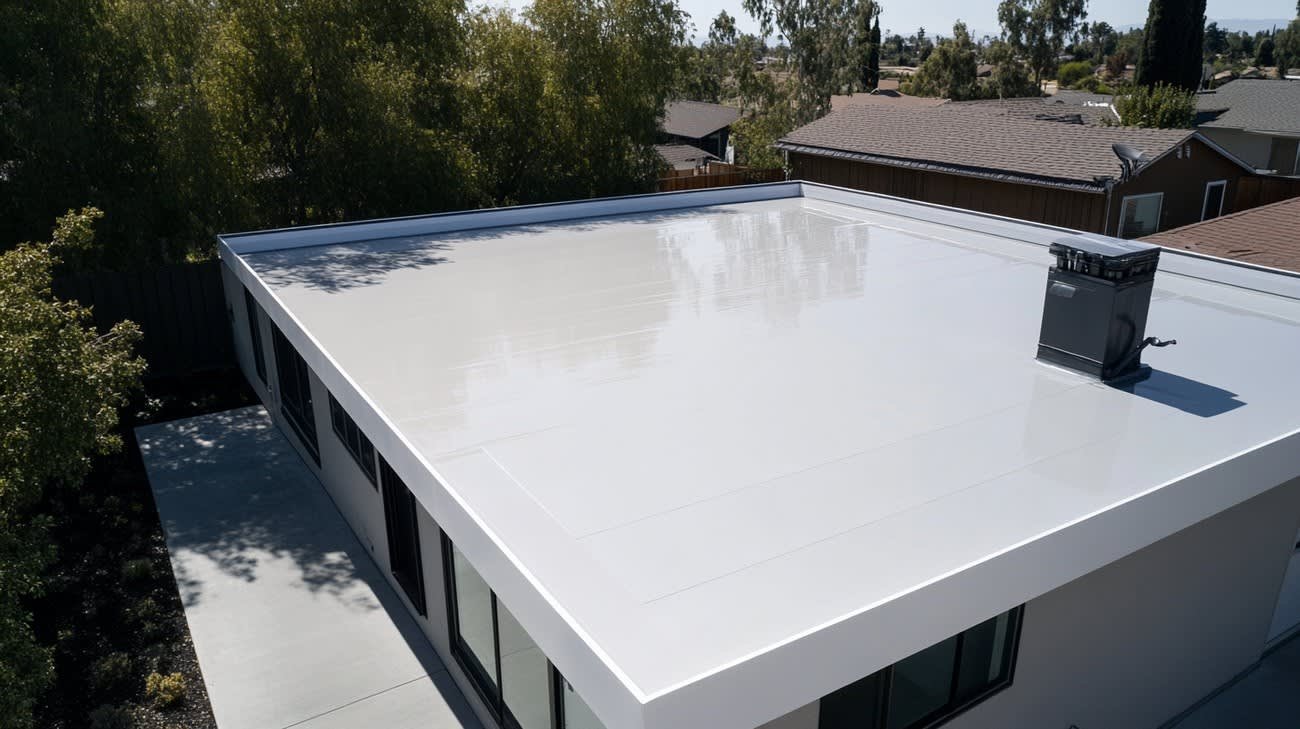
A close-up look at a commercial roofing membrane — the top waterproofing layer discussed in this section.
Understanding how a commercial roof is constructed helps explain why restoration works – and why the structural assessment step matters so much before any work begins.
A commercial roof is not a single layer of material over the building. It is a system of components, each performing a specific function. The three main components of commercial roofing are:
1. The Structural Deck
The deck is the foundation of the entire roofing system – the structural surface that everything above it rests on. On commercial buildings, the deck is most commonly steel (corrugated metal panels), concrete, or occasionally wood or lightweight concrete on older structures.
The deck must be strong enough to support the dead load of the roofing system itself, the live loads from equipment, foot traffic, and snow (in applicable climates), and the dynamic loads from wind. Deck condition is one of the first things evaluated during a restoration assessment – a compromised deck cannot support restoration and requires replacement work before any coating system is applied.
2. The Insulation Layer
Above the deck sits the insulation – typically polyisocyanurate (polyiso), expanded polystyrene (EPS), or extruded polystyrene (XPS) board. Commercial roof insulation serves two purposes: it provides thermal resistance to reduce heating and cooling costs, and it creates the substrate slope that directs water toward drains.
Moisture content in the insulation is the most critical factor in determining whether a roof qualifies for restoration. Wet insulation loses its R-value, creates conditions for mold growth, and adds weight that can stress the deck. Restoration over wet insulation simply does not work – the wet areas must be identified (typically through infrared scanning) and replaced before coating is applied.
This is why a thorough moisture assessment is a non-negotiable step in the Cool Roofs restoration process, not an optional add-on.
3. The Membrane and Surface Layer
The membrane is the waterproofing layer – the material most people mean when they refer to ‘the roof.’ Common commercial membranes include TPO, EPDM, PVC, modified bitumen, and BUR. Above the membrane on some systems sits a surface layer: granules on modified bitumen, gravel on BUR, or simply the exposed membrane surface on single-ply systems.
The membrane’s condition – its intact seams, flashing integrity, and surface weathering – determines what repair work is needed before coating. A restoration coating is applied over the existing membrane; it does not replace it. The membrane must be in sound enough condition to accept and hold the coating system.
Understanding these three layers explains why a building with a weathered membrane but dry insulation and a solid deck is a strong restoration candidate – and why a building with a newer membrane but saturated insulation is not.
What Are the 5 Types of Commercial Roof Construction?
Commercial roofing includes several distinct construction approaches, each with different performance characteristics, installation methods, and restoration profiles. Here are the five main types:
1. Single-Ply Membrane Roofing
Single-ply systems install a single layer of membrane – TPO, EPDM, or PVC – over the insulation and deck. They are the most commonly installed commercial roofing system in North America today due to their relatively low cost, fast installation, and good performance across most commercial applications.
Single-ply membranes are excellent restoration candidates because the large flat surfaces accept fluid-applied coatings evenly and the membrane itself, if in sound condition, provides a stable substrate. The main qualification check is seam integrity – seams that have partially separated need to be re-adhered or reinforced before coating.
Related pages: TPO Roofing, EPDM Roofing, PVC Roofing
2. Built-Up Roofing (BUR)
Built-up roofing is the original commercial flat roofing system – multiple alternating layers of hot asphalt or coal tar pitch and reinforcing felt, topped with gravel ballast or a mineral-surfaced cap sheet. BUR has been used on commercial buildings for over 100 years and remains one of the most durable systems available when properly installed.
BUR is a very strong restoration candidate because the multi-ply construction provides inherent redundancy. Aging BUR systems with intact ply integrity can be cleaned, repaired, and coated to extend their service life significantly. The heavy gravel surface typically needs to be removed before coating – a step that adds labor but opens the membrane for inspection.
3. Modified Bitumen Roofing
Modified bitumen is a modernized asphalt-based system installed in two plies – base sheet and cap sheet – using torch application, cold adhesive, or self-adhered methods. It evolved from BUR to deliver similar multi-ply performance with faster, more flexible installation.
Modified bitumen is one of the most commonly restored roofing systems in Texas because it is widely installed, ages predictably, and responds well to fluid-applied coating systems. The granule-surfaced cap sheet is cleaned before coating, and any seam or blister issues are addressed before the coating system is applied.
Learn more: Modified Bitumen Roofing – Cool Roofs
4. Metal Roofing
Commercial metal roofing – most commonly standing seam or R-panel steel – is installed on low-slope and steep commercial buildings. Metal roofs are extremely durable and long-lived (30-50 years), but they develop common issues over time: rust at fastener points, seam separation from thermal expansion and contraction, and degraded sealants at penetrations and ridge caps.
Metal roof restoration typically involves rust treatment, seam reinforcement with fabric tape, re-sealing of penetrations and flashings, and application of a reflective elastomeric coating. The result is a roof that looks new, is fully waterproof again, and has had its reflectivity significantly improved – with a 10-20 year coating warranty.
Cool Roofs offers Commercial Metal Roofing services, including repair and restoration for aging commercial metal systems.
5. Spray Polyurethane Foam (SPF) Roofing
SPF roofing is a unique system where liquid polyurethane components are sprayed onto the roof surface, expand into rigid foam, and are then top-coated with a protective elastomeric coating. It is self-flashing, seamless, and provides both insulation and waterproofing in a single system.
SPF roofs require re-coating every 10-15 years as the top coating weathers. This re-coating is itself a form of restoration – rather than tearing off the foam, a new coating layer is applied over the existing system. This makes SPF one of the most inherently restorable roofing systems in the industry, with each re-coat cycle extending the roof’s life indefinitely.
What Is the Process of Roof Restoration? Step by Step
Commercial roof restoration follows a systematic sequence. Skipping or shortcutting any step compromises the final result – which is why choosing a contractor who follows a rigorous process matters as much as the coating products used.
Here is the full Cool Roofs restoration process, step by step.
Step 1: Comprehensive Roof Inspection and Condition Assessment
The process begins with a thorough professional inspection – not a quick walk-around, but a systematic evaluation of every aspect of the existing roof system. This is the most important step because it determines whether restoration is viable, what repairs are required, and which coating system is appropriate.
The inspection covers:
- Membrane condition – surface weathering, cracking, blistering, granule loss
- Seam integrity at all laps, T-joints, and terminations
- Flashing condition at penetrations, parapet walls, drains, HVAC curbs, and edge metal
- Drain and scupper condition and flow capacity
- Evidence of ponding water areas
- Deck condition at accessible inspection points
- Interior evidence of active leaks or moisture intrusion
Cool Roofs documents every finding with detailed photography and produces a written condition report. This report becomes the basis for the restoration scope of work and the proposal.
Step 2: Infrared Moisture Scan (When Indicated)
When the visual inspection suggests potential moisture in the insulation – or as a standard precaution on roofs over 15 years old – an infrared thermographic scan is performed. Infrared scanning identifies wet insulation by detecting the thermal signature of moisture-laden areas, which retain heat differently than dry insulation after sunset.
Wet insulation areas identified in the scan must be removed and replaced before restoration coating is applied. Restoration over wet insulation will fail – the moisture prevents proper adhesion and continues to degrade the roof assembly from within. If more than approximately 25% of the insulation is wet, full replacement becomes the more economical option.
Step 3: Detailed Proposal and Coating System Selection
Based on the inspection and moisture scan results, Cool Roofs produces a detailed restoration proposal that includes:
- The full scope of repair work required before coating
- The specific coating system recommended for the existing membrane type
- Material specifications and manufacturer warranty terms
- Project timeline and daily schedule
- Itemized pricing with no hidden fees
Coating system selection matters. Not all coatings are compatible with all membrane types – acrylic, silicone, polyurethane, and butyl rubber coatings each have different adhesion characteristics, performance profiles, and warranty structures. The right coating is matched to the existing membrane, the roof’s slope and drainage, and the project’s performance goals.
Step 4: Surface Preparation and Cleaning
Once the project is approved, surface preparation begins – and this is where the quality of a restoration project is largely determined. A coating applied over a dirty, contaminated, or inadequately prepared surface will delaminate, blister, or fail prematurely regardless of the product’s quality.
Surface preparation typically includes:
- High-pressure or low-pressure power washing to remove dirt, algae, ponding water deposits, and chalking from the membrane surface
- Removal of loose gravel ballast on BUR systems
- Cleaning of all drains, scuppers, and gutters – see our Gutter Cleaning services for commercial properties
- Cleaning of flashings, edge metal, and penetrations
- Allowing the surface to dry completely before any repair or coating work begins
Drying time is non-negotiable. Moisture trapped beneath a coating system is a primary cause of blistering and delamination. In Texas’s humid climate, this step requires careful scheduling around weather conditions.
Step 5: Repairs and Reinforcement
With the surface clean and dry, all repair work identified in the inspection is completed before any coating is applied. This is one of the most critical differentiators between a quality restoration and a paint-over job.
Repair work typically includes:
- Seam repairs: Lifting or separating seams are re-adhered, re-welded (on TPO/PVC), or re-sealed with compatible adhesive and allowed to cure before coating.
- Blister and crack repairs: Blisters are opened, allowed to dry, and patched with compatible membrane material. Cracks are cleaned, primed, and filled.
- Flashing replacement or repair: Deteriorated flashings at penetrations, drains, HVAC curbs, and parapets are replaced or re-sealed. Flashing is the most common source of active leaks and must be in sound condition before coating – if active leaks exist, our Roof Leak Repair team addresses them as part of the restoration scope.
- Wet insulation replacement: Areas identified in the moisture scan are cut out, dried, and replaced with matching insulation before the surrounding membrane is patched.
- Fabric reinforcement at stress points: High-movement areas – drains, penetrations, seam intersections, and corners – receive embedded polyester fabric reinforcement in the base coat for added puncture and tear resistance.
Step 6: Primer Application (Where Required)
Some membrane types – particularly aged EPDM, smooth-surfaced modified bitumen, and metal – require a primer coat before the main coating system to ensure proper adhesion. The primer is applied after repairs are complete and allowed to tack before the base coat is applied.
Skipping the primer on a membrane type that requires it is one of the most common shortcuts that leads to coating delamination. The manufacturer’s application guide for the specific coating system specifies whether priming is required – and a contractor who follows those specs protects both the warranty and the long-term performance of the system.
Step 7: Base Coat Application
Cool Roofs’ professional coating systems deliver the reflective, waterproof finish applied in the base and finish coat steps.
The base coat is the first layer of the coating system – applied at a specified wet mil thickness using spray, roller, or brush application depending on the coating type and roof geometry. The base coat establishes the primary waterproofing layer and the substrate for the finish coat.
At drains, penetrations, seams, and any reinforced areas, additional base coat is applied into the embedded fabric (installed in Step 5) to create a fully reinforced, monolithic waterproofing detail – the most vulnerable points on any flat roof are fully encapsulated before the finish coat is applied.
Base coat coverage rates are specified in gallons per square foot – not estimated visually. Quality contractors measure wet film thickness to ensure specified coverage is achieved, because under-application of coating is the most common cause of premature warranty voidance.
Step 8: Finish Coat Application
Once the base coat has cured to the specified degree, the finish coat is applied. On most systems, the finish coat is a bright white reflective coating – delivering the Energy Star-rated solar reflectance that is one of restoration’s primary performance benefits. Some systems use a tinted or specialty finish coat depending on the building’s requirements.
The finish coat is applied at the specified thickness to achieve the total dry film thickness required by the warranty. As with the base coat, coverage is measured – not estimated. The finish coat also determines the coating system’s UV protection, which is what gives the system its long service life.
Our Commercial Roof Coatings page covers the specific coating systems Cool Roofs installs and their performance specifications.
Step 9: Quality Inspection and Documentation
After the coating is fully applied and cured, a final inspection is conducted to verify:
- Uniform coverage across all field areas
- All details – drains, penetrations, flashings, edges – are fully coated and reinforced
- Dry film thickness readings confirm specified coverage was achieved
- The roof is clean and free of debris
- All drains and gutters are clear and flowing
Cool Roofs documents the completed project with a full photo set and provides the building owner with the manufacturer warranty registration documentation, the project completion report, and maintenance guidance for the restored system.
Step 10: Ongoing Maintenance Program
A restored roof is an investment that benefits significantly from a structured maintenance program. Cool Roofs recommends:
- Professional inspections twice per year – spring and fall – to catch any issues before they develop
- Post-storm inspection after significant hail or wind events – see our Storm Damage Repair services, which include commercial post-storm assessment
- Annual drain and gutter cleaning to prevent ponding water
- Prompt repair of any mechanical damage from rooftop work or equipment
Following the manufacturer’s maintenance requirements is typically required to keep the coating warranty valid. Many manufacturers offer extended warranty options for buildings enrolled in documented maintenance programs.
Roof Restoration vs. Full Replacement: Which Is Right for Your Building?
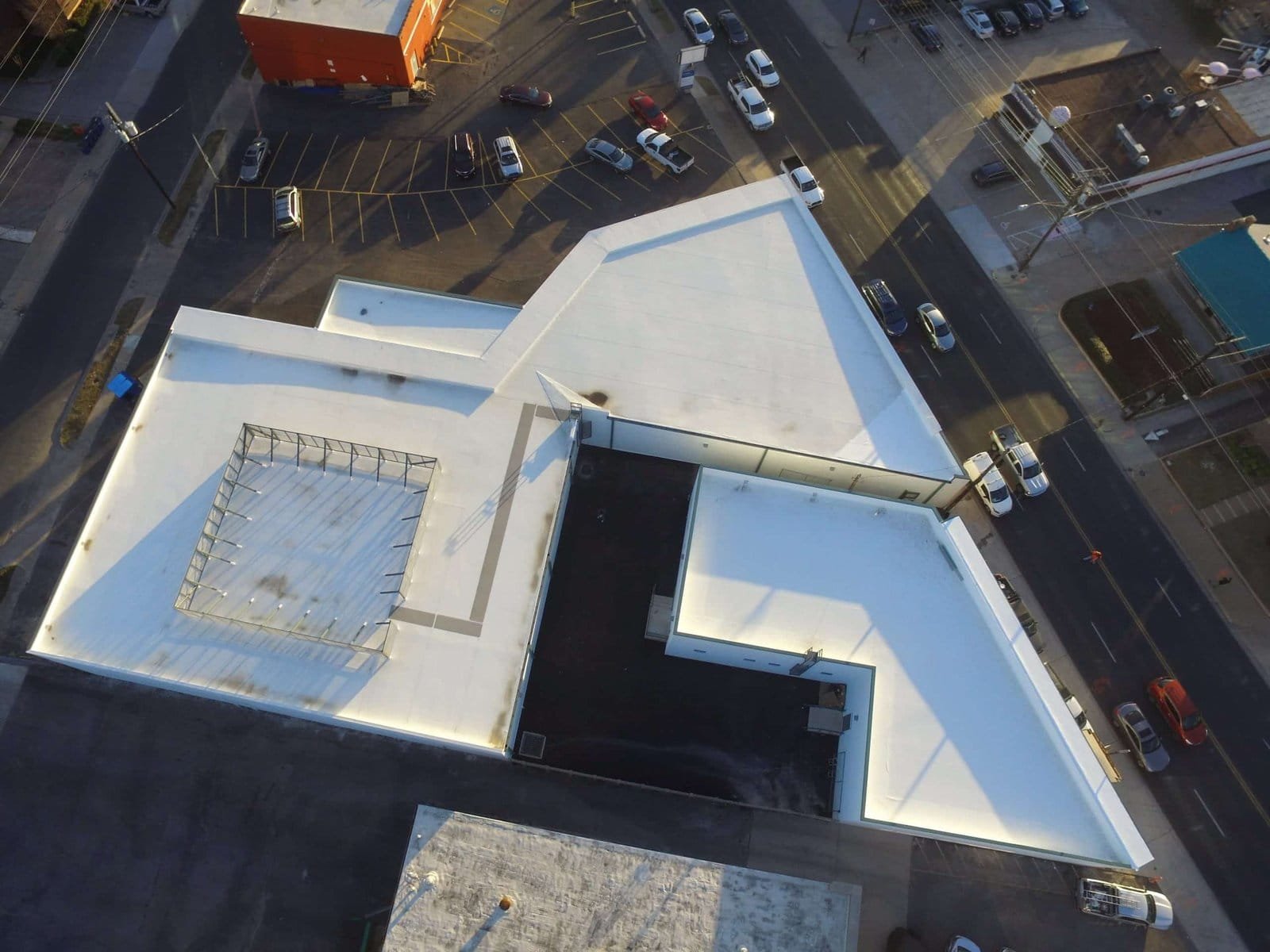
A completed commercial roofing project — restoration delivers comparable performance to replacement at a fraction of the cost and disruption.
The decision between restoration and replacement comes down to the roof’s current condition, moisture levels in the insulation, and total cost of ownership over the building’s planned ownership horizon.
| Factor | Restoration | Full Replacement |
| Typical Cost | 30-50% of replacement cost | Full tear-off + new system |
| Business Disruption | Minimal – building stays operational | Significant – loud, disruptive tear-off |
| Time to Complete | 1-5 days (most projects) | 5-14+ days depending on roof size |
| Life Extension | 10-15 additional years | Full new lifespan (15-30 yrs) |
| Landfill Waste | None – existing roof stays | Old membrane, insulation disposed |
| Coating Warranty | 10-20 years (manufacturer) | New system warranty |
| Best When | Roof is structurally sound, <25% wet insulation | Widespread failure or multiple layers exist |
The general rule: if the roof is structurally sound, the insulation is dry, and the membrane is in repairable condition, restoration delivers superior value. If the roof has reached end of life, has widespread moisture, or has already been restored once, replacement is the better long-term investment.
Our article How to Tell If Your Commercial Roof Needs Repair or Full Replacement goes deeper on this decision framework.
Commercial Roof Restoration in Texas: What Makes It Different
Texas presents specific conditions that both increase the urgency of restoration and affect how the process is executed.
- Intense UV degradation: Texas’s solar radiation accelerates coating weathering faster than in most other markets. This makes white reflective coatings – which are standard in restoration – particularly valuable: they reflect heat before it can degrade the membrane, reducing thermal cycling and extending the system’s life.
- Hail damage assessment: After a significant hail event, even a recently restored roof should be professionally inspected. Hail impacts that bruise the coating without visible penetration can still compromise the system’s integrity over time. Our Storm Damage Repair team provides post-storm documentation for insurance claims.
- Scheduling around weather: Coating application requires dry conditions and temperatures within the product’s application range. Texas’s unpredictable spring and summer storm patterns require close weather monitoring and flexible scheduling. Restoration is typically best scheduled in fall or winter in Texas for most regions.
- Energy savings are immediate: A white reflective coating on a Texas commercial building that previously had a dark or weathered membrane can reduce rooftop surface temperatures by 50-80 degrees F, with measurable cooling cost reductions from the first summer after installation.
Cool Roofs serves commercial restoration clients across Texas and Tennessee including Austin, Houston, San Antonio, Fort Worth, Beaumont, New Braunfels, and Memphis.
Further Reading From the Cool Roofs Blog
- Modified Bitumen vs. Other Flat Roofs: Which Wins?
- PVC vs TPO Roofing: Which Is Right for Texas Buildings?
- Why TPO Roofing Is the Most Popular Choice for Texas Commercial Buildings
- How Long Does a PVC Roof Last? (And How to Maintain It)
- Best Roofing Systems for Warehouses and Manufacturing Facilities
Frequently Asked Questions
What is commercial roof restoration?
Commercial roof restoration is the process of renewing an aging but structurally sound commercial roof by cleaning the surface, repairing all defects, and applying a fluid-applied coating system that restores waterproofing and reflectivity. It extends the roof’s service life by 10-15 years at roughly 30-50% of the cost of full replacement, with no tear-off and minimal business disruption.
How long will a commercial roof last?
Lifespan varies by system: single-ply membranes (TPO, EPDM, PVC) typically last 15-25 years; modified bitumen 15-20 years; built-up roofing 15-30 years; metal 30-50 years. With professional installation, regular maintenance, and one or more restoration cycles, many commercial roofs can serve a building for 30-40+ years before requiring full replacement.
How is a commercial roof built?
A commercial roof is a system of three main components: the structural deck (steel, concrete, or wood), the insulation layer (polyiso, EPS, or XPS board), and the membrane or surface layer (TPO, EPDM, PVC, modified bitumen, BUR, or metal). Each component performs a distinct function, and the condition of each affects whether the roof qualifies for restoration.
What are the three main components of commercial roofing?
The three main components are: (1) the structural deck – the foundation that supports everything above; (2) the insulation layer – providing thermal resistance and drainage slope; and (3) the membrane and surface layer – the waterproofing material that protects the building from weather. Restoration primarily addresses the membrane and surface layer, though insulation issues identified during assessment must also be resolved.
What are the 5 types of commercial roof construction?
The five main types are: (1) single-ply membrane roofing (TPO, EPDM, PVC); (2) built-up roofing (BUR); (3) modified bitumen; (4) metal roofing (standing seam, R-panel); and (5) spray polyurethane foam (SPF). Each type has different restoration requirements and compatible coating systems.
Does my commercial roof qualify for restoration?
The primary qualifications are: the existing membrane is in repairable condition (no widespread cracking or delamination), the insulation is dry in at least 75-80% of its area, and the structural deck is sound. A professional inspection including infrared moisture scanning is the only reliable way to confirm qualification. Cool Roofs offers free inspections for commercial properties.
How much does commercial roof restoration cost?
Restoration typically costs 30-50% of full replacement cost. For a 10,000 square foot commercial roof, a full replacement might cost $80,000-$150,000; restoration of the same roof might run $25,000-$60,000 depending on the extent of repairs required, coating system selected, and roof complexity. A professional inspection and detailed proposal is the only accurate way to budget your specific project.
How long does roof restoration take?
Most commercial restoration projects are completed in 1-5 days for typical building sizes. The timeline depends on roof size, the extent of repair work required, coating system cure times, and weather. Metal or BUR roofs with extensive preparation work may take longer. Unlike full replacement, restoration allows normal building operations to continue throughout the process with minimal disruption.
How do I get started with a commercial roof restoration?
The first step is a professional inspection to assess your roof’s condition and determine whether it qualifies for restoration. Cool Roofs provides free commercial roof inspections with a full photo report and transparent proposal. Visit our Commercial Roof Restoration Services page or call 844-939-2665 to schedule.
Ready to Extend Your Commercial Roof’s Life?
Commercial roof restoration is one of the smartest financial decisions a building owner can make – when the roof qualifies and the work is done correctly. It saves tens of thousands of dollars compared to premature replacement, delivers measurable energy savings, and protects your building under a new manufacturer-backed warranty.
Cool Roofs has completed 2,000+ roofing projects across Texas and Tennessee, with a team of certified specialists who follow a rigorous, documented restoration process from inspection to final warranty registration.
Explore our Commercial Roof Restoration Services, browse completed projects, or call 844-939-2665 to book your free commercial roof inspection today.