
When a commercial roof starts showing signs of age, building owners face a decision that can run into six figures: restore the existing roof system or tear it off and start fresh. It is one of the most financially significant choices a property owner makes – and it is one where the wrong answer is surprisingly easy to arrive at without good information.
The honest answer is that restoration saves more money in most situations – but not all. Whether restoration is the right call depends on the roof’s current condition, the moisture level in the insulation, the age of the system, and how long you plan to own the building. When those factors align, restoration typically costs 30-50% of what replacement would – and delivers a renewed roof under a manufacturer-backed coating warranty.
This guide breaks down everything you need to make the right call: a direct cost comparison, the truth about whether restoration works, how long restorations last, what causes roofs to fail early, when replacement is genuinely the better option, how to estimate replacement cost, and the cheapest time of year to schedule either project in Texas.
If you want to jump straight to your options, visit our Commercial Roof Restoration Services page or our Commercial Roofing page for a full picture of what Cool Roofs offers.
Roof Restoration vs. Replacement Cost: The Real Numbers
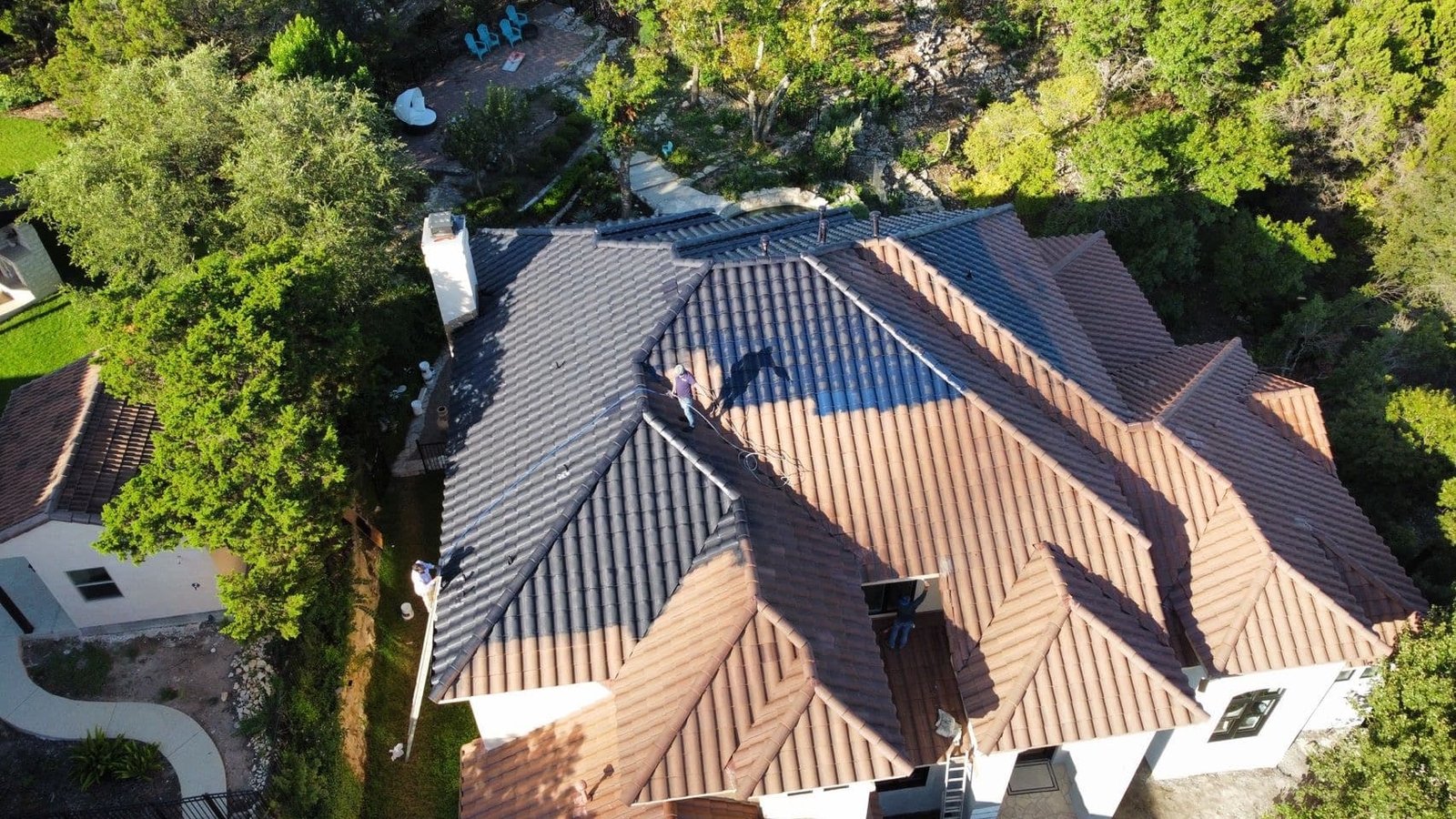
A full roof replacement in progress — the six-figure decision this guide helps you avoid making blind.
Cost is where the decision usually begins – and where restoration’s advantage is clearest.
Commercial roof restoration typically costs $2.50 to $5.00 per square foot installed, depending on the extent of repairs required, the coating system selected, and the size and complexity of the roof. Full replacement of a commercial roof typically costs $4.00 to $14.00 per square foot depending on the membrane system.
Here is a size-by-size cost comparison across common commercial roof sizes:
| Roof Size | Restoration Cost (est.) | Full Replacement Cost (est.) | Savings With Restoration |
| 2,500 sq ft | $7,500 – $15,000 | $25,000 – $50,000 | $17,500 – $35,000 |
| 5,000 sq ft | $15,000 – $30,000 | $50,000 – $100,000 | $35,000 – $70,000 |
| 10,000 sq ft | $30,000 – $55,000 | $80,000 – $150,000 | $50,000 – $95,000 |
| 20,000 sq ft | $55,000 – $100,000 | $150,000 – $280,000 | $95,000 – $180,000 |
| 50,000 sq ft | $130,000 – $230,000 | $350,000 – $650,000 | $220,000 – $420,000 |
Important note: These figures are general estimates for budgeting purposes. Actual costs depend on roof condition, repair scope, market conditions, and material specifications. The only accurate estimate is one based on a professional inspection of your specific roof.
The savings are significant at every size – but the real financial story goes deeper than the installation cost alone.
Hidden Cost Savings in Restoration
The installed cost difference is only part of the financial picture. Restoration also saves money in ways that do not appear in the per-square-foot comparison:
- No tear-off cost: Full replacement includes the cost of removing the existing roof – typically $0.50 to $2.00 per square foot in additional labor and disposal fees. On a 20,000 square foot roof, that is $10,000 to $40,000 just to remove the old system before installing the new one.
- No landfill disposal fees: Roofing tear-off generates significant waste – old membrane, insulation, and fasteners that must be hauled away and disposed of. These fees are real and add to replacement cost.
- No business interruption cost: Restoration is completed with the building fully operational. Full replacement involves loud mechanical tear-off, dust, and potential temporary exposure of the building interior. For retail, hospitality, healthcare, and office tenants, this disruption has measurable cost.
- Energy savings begin immediately: A white reflective coating applied during restoration can reduce rooftop surface temperatures by 50-80 degrees F compared to an aged dark membrane, delivering measurable reductions in cooling costs from the first summer after installation. Our Commercial Roof Coatings page covers the performance specifications of the coating systems we install.
- Potential tax advantage: In many cases, restoration costs can be expensed immediately as a maintenance or repair cost rather than being capitalized and depreciated over years the way a full replacement typically is. Consult your accountant – this distinction can have meaningful cash-flow implications.
Restoration vs. Replacement: Side-by-Side Comparison
Here is a comprehensive view of how the two options compare across every factor that matters to a commercial building owner:
| Factor | Restoration | Full Replacement |
| Upfront Cost | 30-50% of replacement | 100% – full new system |
| Life Extension | 10-15 years per cycle | Full new lifespan (15-30 yrs) |
| Business Disruption | Minimal – stays open | Significant tear-off noise and debris |
| Project Duration | 1-5 days typical | 5-14+ days |
| Landfill Waste | Zero – existing roof stays | Old membrane, insulation disposed |
| Warranty | 10-20 yr coating warranty | 15-30 yr system warranty |
| Energy Improvement | Significant – white coating added | Depends on new system chosen |
| Requires Dry Insulation | Yes – wet insulation disqualifies | No – insulation replaced too |
| Can Be Done Multiple Times | Yes – re-coatable after 10-15 yrs | One-time structural reset |
| Tax Treatment (US) | Often expensed immediately | Depreciated over years |
| Best When | Structurally sound, <25% wet insulation | Widespread failure, end-of-life, or 2+ layers |
Does Roof Restoration Actually Work?
This is the most important question – and the answer is yes, when the roof qualifies and the work is done correctly.
The skepticism around roof restoration usually comes from one of two sources: either someone encountered a low-quality ‘coating job’ that was applied over an unrepaired roof as a quick fix, or they are comparing restoration to new construction and expecting identical outcomes. Properly executed restoration is neither of those things.
Here is what the evidence actually shows:
Manufacturer Warranties Back the Performance
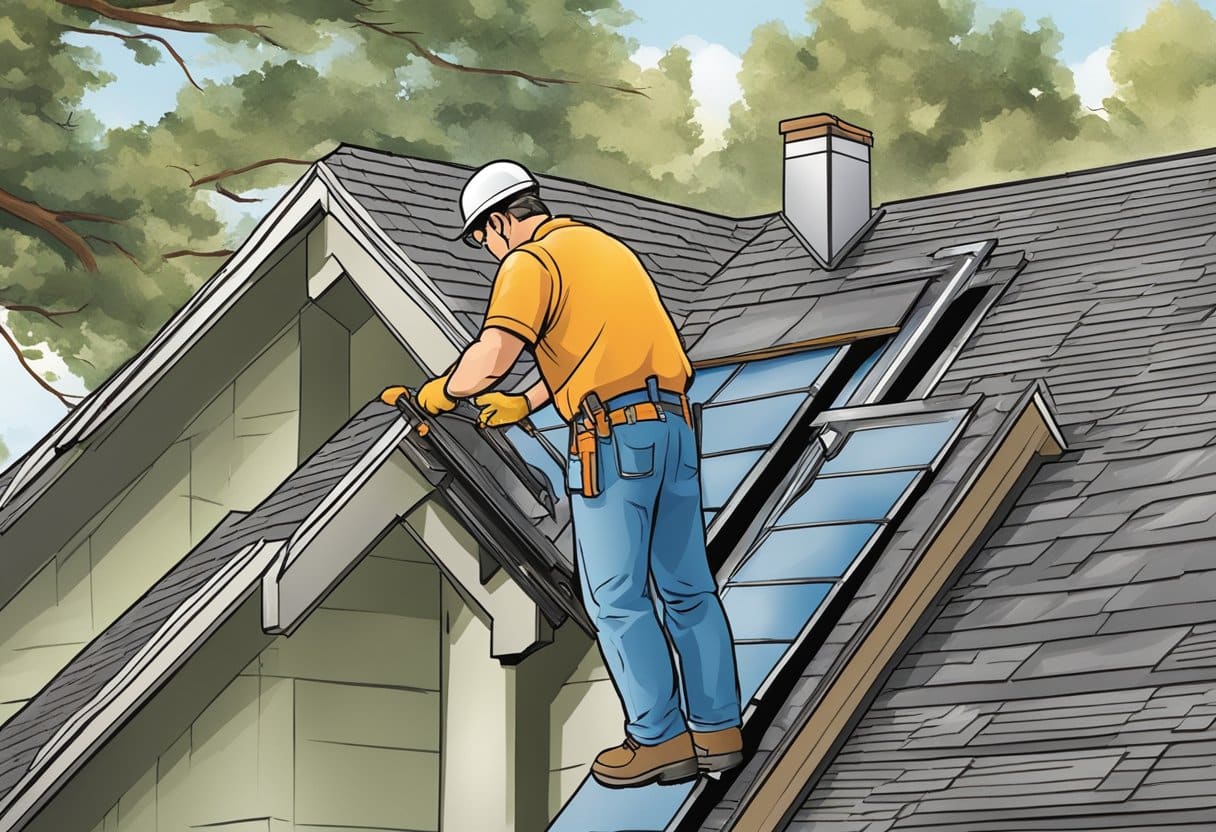
Cool Roofs is a GAF Master Contractor — certified to install and back manufacturer-warrantied roofing and coating systems.
Leading coating manufacturers – Sherwin-Williams, Tremco, Polyglass, Henry, GAF, and others – provide material warranties of 10-20 years on properly applied restoration systems. These are not marketing claims; they are contractual obligations backed by companies with decades of commercial roofing history. Manufacturers would not issue 20-year warranties on products that do not perform.
The catch: these warranties require installation by a certified contractor following the manufacturer’s application specifications – correct surface prep, correct primer, correct coverage rates, correct dry film thickness. A restoration done correctly meets or exceeds those specs; a cut-rate coating job typically does not.
Infrared Scanning Eliminates the Guesswork
One of the reasons restoration has historically had mixed results is that coatings were sometimes applied over roofs with wet insulation – insulation that was saturated with moisture from slow, undetected leaks. Coating over wet insulation causes blistering and delamination as trapped moisture continues to move through the system.
Modern infrared thermographic scanning eliminates this problem by identifying wet insulation areas precisely before any work begins. Wet areas are removed and replaced as part of the restoration scope. The result is a coating applied over a dry, structurally sound substrate – which is exactly what a quality restoration requires.
Cool Roofs includes infrared moisture scanning as a standard part of our restoration assessment process. No restoration begins without a confirmed moisture map of the existing roof.
Restoration Performance in Texas Conditions
Texas is a demanding test environment for roofing – intense UV radiation, temperature extremes from 10 to 110 degrees F, hurricane-season humidity along the Gulf Coast, and significant hail risk across the interior. A restoration coating that performs reliably in Texas conditions performs reliably anywhere.
The reflective coatings used in commercial restoration – primarily silicone, acrylic, and polyurethane formulations – are specifically formulated for UV and thermal resistance. Their reflective properties are actually an advantage in Texas that less-reflective replacement membranes may not match: a freshly coated modified bitumen or TPO roof reflects more solar radiation than an aged, chalked replacement membrane.
How Long Do Roof Restorations Last?
A professionally executed commercial roof restoration with a quality coating system lasts 10-15 years under normal conditions. At the end of that period, the roof can typically be re-coated again – extending the life by another 10-15 years – without returning to full replacement, provided the underlying membrane remains in sound condition.
This cyclical model is one of restoration’s most powerful financial arguments. Consider a building owner who restores a 15-year-old modified bitumen roof instead of replacing it:
- Year 0: Restoration at 30-50% of replacement cost. New 15-year coating warranty.
- Year 12-15: Re-coating assessment. If membrane is sound, re-coat again at similar cost. Another 10-15 years added.
- Year 25-30: Assessment. At this point, the underlying membrane may have reached end of life – full replacement appropriate.
The result: two restoration cycles instead of one replacement cycle, covering 25-30 years of service at roughly the same total cost as one replacement – while delivering better energy performance throughout due to the reflective coating surface.
Factors that affect restoration lifespan:
- Coating system quality: Premium silicone coatings with high solids content typically outlast lower-cost acrylic formulations in high-UV environments like Texas.
- Applied coverage rate: Under-application of coating is the most common cause of premature warranty voidance. Correct wet mil thickness must be verified during application – not estimated.
- Ongoing maintenance: Annual inspections, prompt repair of mechanical damage, and clear drains extend coating life. Our Commercial Roofing team provides post-restoration maintenance programs.
- Drainage quality: Ponding water accelerates coating degradation. Buildings with drainage issues should have those addressed as part of the restoration scope.
How Many Years Should You Replace Your Roof?
There is no universal replacement timeline – the right answer depends on the roofing system, the installation quality, the climate, and how consistently the roof has been maintained. Here is a realistic guide by system type:
- Standard asphalt shingles (residential): Replace at 20-25 years, or sooner if significant granule loss, curling, or storm damage is present.
- Architectural/designer shingles (residential): Replace at 25-30 years under normal conditions.
- TPO (commercial): Assess for restoration at 12-15 years; replace at 20-25 years if restoration is no longer viable.
- Modified Bitumen (commercial): Assess for restoration at 10-15 years; replace at 18-22 years.
- EPDM (commercial): Assess for restoration at 15 years; replace at 22-25 years.
- PVC (commercial): Longer native lifespan (20-30 years); assess for restoration or replacement at 20-25 years.
- Metal (commercial): Restoration (coating) typically at 15-20 years for rust and seam issues; full replacement rarely needed before 40+ years with proper maintenance.
In Texas, these timelines compress slightly due to the state’s demanding climate. UV intensity, thermal cycling, and storm exposure all accelerate normal wear. A TPO roof that might reach 22 years in a moderate climate may need attention at 17-18 years in Texas without a restoration cycle.
The most reliable indicator is not calendar age – it is condition. A professional inspection with infrared scanning gives you an objective assessment of where your roof actually stands, regardless of how old it is. Our Roof Inspection Services are available for both residential and commercial roofs.
What Are Common Causes of Roof Failure?
Understanding why roofs fail helps building owners make better maintenance and replacement decisions – and identify which failure mode their roof may be heading toward.
1. Poor Installation Quality
Installation quality is the single most important determinant of roof lifespan. Improperly welded seams on TPO or PVC, under-fastened modified bitumen, or inadequate flashing at penetrations creates vulnerabilities from day one that compound over time. Hiring an unlicensed or inexperienced contractor is the fastest path to premature roof failure.
2. Inadequate or Failed Drainage
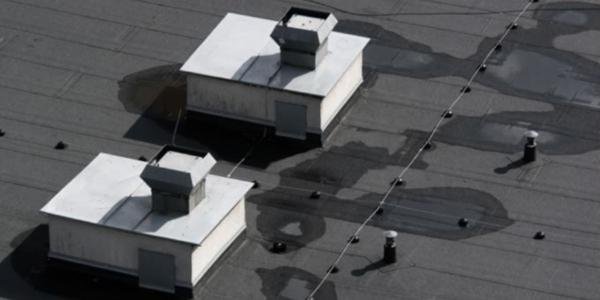
Clogged or poorly sloped drains cause ponding water — one of the most common accelerators of membrane failure.
Flat roofs are designed to drain water quickly – but clogged drains, improperly sloped installation, or settled insulation can create ponding water areas. Standing water accelerates membrane degradation, adds structural load, and creates freeze-thaw stress in applicable climates. Our Gutter Cleaning services address one of the most common causes of drainage failure.
3. Storm and Hail Damage
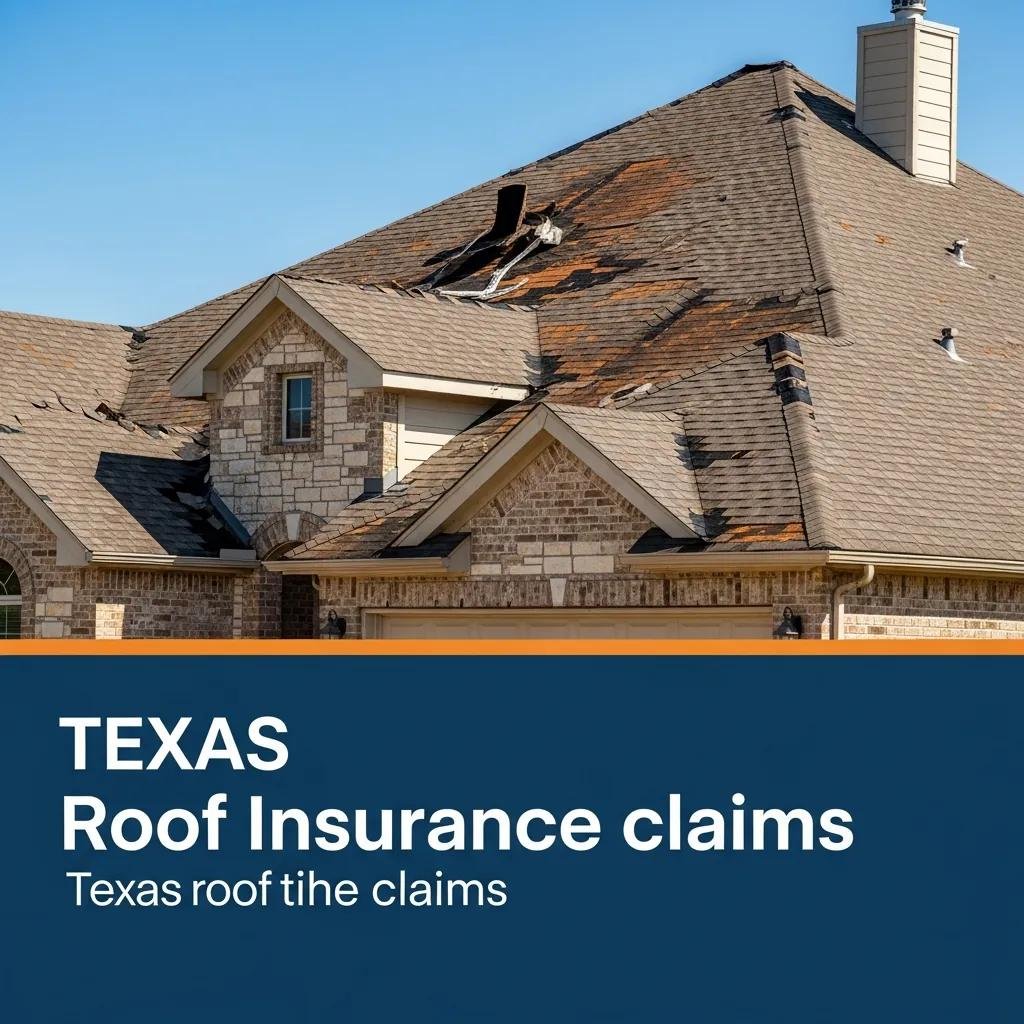
Hail and storm impacts often bruise a roof without immediately penetrating it — damage that surfaces as leaks months later if not inspected.
In Texas, hail is one of the most common causes of roof damage and premature failure. Impacts that do not immediately penetrate the membrane can still bruise it in ways that accelerate UV degradation and lead to leaks months or years later. After every significant hail event, a professional inspection should be scheduled – not a visual check from the ground.
Our Storm Damage Repair team provides post-storm assessments and insurance documentation services for both residential and commercial roofs.
4. Deferred Maintenance and Ignored Minor Damage
Small issues – a lifted flashing, a minor blister, a partially open seam – are inexpensive to fix when caught early. The same issues left unaddressed for one or two Texas rain seasons can lead to wet insulation, structural deck damage, and interior water damage that converts a $500 repair into a $50,000 problem. The most cost-effective roofing strategy is a consistent inspection and maintenance schedule.
5. UV and Thermal Degradation
All roofing materials degrade under UV exposure and thermal cycling over time. Dark membranes absorb heat that lighter membranes reflect, accelerating this process. In Texas, a building with a dark EPDM or aged modified bitumen membrane is experiencing significantly more thermal stress than one with a white reflective surface. Restoration coatings specifically address this by resurfacing the roof with a highly reflective finish.
6. Foot Traffic and Mechanical Damage
Every HVAC technician, solar installer, or maintenance crew member who accesses the roof without walk pads or rooftop traffic protocols is a potential source of membrane punctures. Over time, repeated unprotected foot traffic – especially around HVAC equipment – creates clusters of damage that eventually compromise the membrane. Walk pads and rooftop traffic policies are inexpensive prevention.
7. Failed or Deteriorated Flashings
Flashings at penetrations, parapet walls, drains, and HVAC curbs are the most vulnerable points on any flat roof. They are typically the first areas to show wear and are disproportionately responsible for active leaks. Regular flashing inspection and prompt re-sealing when deterioration is found prevents the majority of commercial flat roof leaks. Our Roof Leak Repair team handles flashing repair and emergency leak response.
What Is the Cheapest Time of Year to Get a New Roof (or Restoration)?
Timing a roofing project correctly can meaningfully affect your cost – particularly for full replacement, where contractor demand and material pricing fluctuate with the seasons.
| Season | Restoration Suitability | Replacement Suitability | Notes |
| Spring (Mar-May) | Good – mild temps, some rain risk | Good | Best for restoration before summer heat; watch storm season |
| Summer (Jun-Aug) | Challenging – extreme heat | Challenging – heat/storms | High demand = higher prices; coating cures fast but heat stresses crew |
| Fall (Sep-Nov) | Excellent – optimal conditions | Excellent | Best overall window for TX; mild temps, low rain risk, contractor availability |
| Winter (Dec-Feb) | Good – low demand pricing | Good – lowest prices | Coldest window; some coating products have temp minimums |
For Roof Restoration
Fall – September through November – is the optimal window for restoration in Texas. Temperatures are mild, humidity is lower than summer, and rainfall is less frequent than spring. Coating products cure best in moderate temperatures (50-90 degrees F), and contractor availability is typically better in fall than in the peak spring and summer storm-repair season.
Winter (December through February) is also a viable restoration window in most Texas markets and often offers the lowest pricing due to reduced demand. The primary constraint is that some coating products have minimum application temperature requirements – typically 40-50 degrees F – which limits very cold days but rarely eliminates an entire Texas winter as an option.
For Full Replacement
Late fall and winter typically offer the best pricing on full roof replacement. Roofing contractors are less busy, material suppliers may offer off-season pricing, and there is less competition for scheduling. For a large commercial replacement project, a winter start date can save 5-15% compared to peak spring demand season.
Avoid scheduling a large replacement project in April through June in Texas – this is when hail season is at its peak, contractors are busiest with storm repair work, and pricing tends to be highest. If a storm damages your roof and forces emergency replacement, those timing advantages disappear, which is one more reason to address aging roofs proactively before they fail.
How to Estimate Roof Replacement Cost
Several factors determine the cost of a commercial roof replacement. Here is a framework for building a realistic budget estimate before you receive formal proposals.
Step 1: Know Your Roof Size
Roof area is measured in squares (one square = 100 square feet) or total square feet. For a simple rectangular building, multiply length by width. For complex roofs with multiple levels, hips, or penetrations, the measured area will differ from the building footprint – a professional measurement is more reliable than a floor-plan estimate.
Step 2: Choose a System and Apply Cost Per Square Foot
Use these ranges as a starting point for Texas commercial roofing:
| Roof Type | Installed Cost Per Sq Ft | 10,000 Sq Ft Estimate |
| TPO (single-ply) | $3.50 – $7.00 | $35,000 – $70,000 |
| EPDM (rubber) | $4.00 – $8.00 | $40,000 – $80,000 |
| Modified Bitumen | $4.00 – $8.00 | $40,000 – $80,000 |
| PVC (single-ply) | $5.00 – $9.00 | $50,000 – $90,000 |
| Metal Roofing | $7.00 – $14.00 | $70,000 – $140,000 |
| Built-Up Roofing (BUR) | $5.00 – $10.00+ | $50,000 – $100,000+ |
For residential roofing, standard asphalt shingle replacement runs $4.00 to $8.00 per square foot installed; premium and luxury materials run $8.00 to $20.00+ per square foot. See our Luxury Roofing page for premium residential options.
Step 3: Add Tear-Off, Disposal, and Deck Repair
Add $0.50 to $2.00 per square foot for tear-off and disposal of the existing roof. If the structural deck has damage that requires repair – rot on a wood deck or rust on a steel deck – add an allowance for deck work ($1.00 to $3.00 per square foot for affected areas).
Step 4: Add Insulation Upgrade If Required
Texas energy codes may require R-value upgrades when reroofing a commercial building. New insulation adds $1.50 to $4.00 per square foot depending on thickness and product. Confirm local code requirements with your contractor.
Step 5: Get a Free Online Estimate or Professional Inspection
Online roof cost calculators can give you a ballpark number based on roof size and system type, but they do not account for roof complexity, local market labor rates, deck condition, or the specific scope of your project. The most reliable estimate is a professional inspection followed by a detailed proposal.
Cool Roofs offers a free commercial and residential roof inspection – a $499 value at no charge – that includes a full photo-documented condition report and a transparent, itemized proposal. There is no obligation and no pressure. Visit our Free Quote page or call 844-939-2665 to schedule.
When Is Full Replacement the Right Answer?
Restoration is the right call in most situations – but not all. Here are the conditions where full replacement is the genuinely better investment:
- Widespread wet insulation: If infrared scanning reveals that more than 25% of the insulation is saturated, the cost of cutting out and replacing wet areas often approaches or exceeds full replacement cost. At that point, a full tear-off with new insulation is the more economical path.
- Structural deck damage: If the underlying deck – steel, concrete, or wood – has significant damage, no surface treatment addresses the root problem. Deck repair or replacement requires full tear-off.
- Multiple existing layers: Most building codes allow a maximum of two roofing layers before requiring full tear-off. If a roof already has two layers, restoration or recover is not an option – replacement is the only compliant path.
- End-of-life membrane: A membrane that is brittle, extensively cracked, or showing widespread seam failure across large areas of the roof is not a viable restoration candidate. The substrate must be in repairable condition for a coating system to bond properly and perform.
- Previous restoration approaching 15 years: A roof that has already been restored once and is nearing the end of that coating’s warranty life should be assessed carefully. If the underlying membrane is still sound, re-coating is an option. If the membrane has deteriorated through two cycles, replacement is appropriate.
The decision framework is straightforward: if the roof qualifies for restoration, restoration saves more money. If it does not qualify, replacement is the correct investment – but doing it with a high-quality system rather than the minimum-spec option gives you better long-term value and potentially a future restoration opportunity before the next replacement cycle.
For a detailed breakdown of warning signs and how to tell which option applies to your roof, see our article: How Commercial Roof Restoration Works Step by Step.
Further Reading From the Cool Roofs Blog
- How Commercial Roof Restoration Works Step by Step
- Modified Bitumen vs. Other Flat Roofs: Which Wins?
- PVC vs TPO Roofing: Which Is Right for Texas Buildings?
- Why TPO Roofing Is the Most Popular Choice for Texas Commercial Buildings
- Does a Luxury Roof Increase Home Value in Texas?
Frequently Asked Questions
Is a roof restoration better than a roof replacement?
In most cases, yes – when the roof qualifies. Restoration costs 30-50% of replacement, requires no tear-off, causes minimal business disruption, delivers a new manufacturer warranty, and extends the roof’s life by 10-15 years. The exception is when the roof has widespread wet insulation, structural deck damage, or has reached end-of-life condition where the membrane is no longer repairable. A professional inspection with infrared scanning determines which option is appropriate.
Does roof restoration actually work?
Yes – when done correctly on a qualifying roof. Leading coating manufacturers back properly installed restoration systems with 10-20 year material warranties. The keys to a restoration that performs as warranted are: thorough surface preparation, moisture scanning and replacement of wet insulation before coating, correct application of primer where required, and coating applied at the specified coverage rate. Shortcuts in any of these steps compromise the outcome.
How long do roof restorations last?
A professionally executed restoration with a quality coating system lasts 10-15 years. At that point, the roof can typically be re-coated for another 10-15 year cycle, provided the underlying membrane is still sound. Factors that extend restoration life include high-quality coating products, correct coverage rates, good drainage, and a consistent maintenance program.
How many years should I replace my roof?
Replacement timelines vary by system: standard asphalt shingles at 20-25 years; architectural shingles at 25-30 years; commercial TPO at 15-25 years; modified bitumen at 15-20 years; EPDM at 20-25 years; PVC at 20-30 years; metal at 30-50+ years. In Texas, these compress slightly due to UV and storm exposure. Condition – not calendar age – is the most reliable indicator of when replacement is needed.
What are common causes of roof failure?
The most common causes are: poor original installation quality (especially seam and flashing work), inadequate drainage leading to ponding water, storm and hail damage that goes uninspected, deferred maintenance allowing minor issues to become major ones, UV and thermal degradation (especially on dark membranes), foot traffic damage without walk pads, and failed flashings at penetrations and parapet walls.
What is the cheapest time of year to get a new roof?
In Texas, late fall (October-November) and winter (December-February) typically offer the lowest pricing for both restoration and replacement due to reduced contractor demand. Summer is the most expensive period – high demand from storm repair work drives up pricing and reduces contractor availability. For restoration specifically, fall is ideal due to mild temperatures that optimize coating application and curing.
How do I estimate roof replacement cost?
Multiply your roof area (in square feet) by the per-square-foot cost for your chosen system – $3.50 to $14.00+ depending on material. Add $0.50 to $2.00 per square foot for tear-off and disposal, plus allowances for deck repair and insulation upgrades if needed. For an accurate number on your specific building, request a free inspection and detailed proposal from Cool Roofs.
Is there a free online roof replacement estimate?
Online calculators can give you a rough ballpark based on roof size and system type, but they cannot account for your specific roof’s condition, local labor costs, repair scope, deck condition, or insulation requirements – factors that can significantly affect final cost. The most accurate and truly free estimate is a professional inspection. Cool Roofs offers a free commercial and residential inspection (a $499 value) with no obligation. Visit our Free Quote page or call 844-939-2665 to schedule.
Ready to Find Out Which Option Is Right for Your Roof?
The right answer – restoration or replacement – depends on your specific roof’s condition, not a general rule. The only way to know for certain is a professional inspection with infrared moisture scanning, honest documentation of what is found, and a transparent proposal that puts both options on the table.
That is exactly what Cool Roofs provides. We serve commercial and residential properties across Texas and Tennessee including Austin, Houston, San Antonio, Fort Worth, Beaumont, New Braunfels, Memphis, and New Jersey.
With 10+ years of experience, 2,000+ completed projects, and 500+ five-star reviews, Cool Roofs will tell you the truth about your roof – and give you the most cost-effective path to protecting your building.
Visit our Commercial Roof Restoration Services page or call 844-939-2665 to book your free inspection today.